
2026 President's Medallion

Megi Maci—inspired by her Albanian cultural heritage, upbringing, and mentors—is driven to improve the health of vulnerable populations and to practice medicine in a compassionate, dignified, and human-centered way.
Aspiring physician leader Megi Maci receives President’s Medallion
Megi Maci is an aspiring physician leader pursuing Obstetrics and Gynecology (OB/GYN) who is committed to making a difference in the world. She was born in Albania in the aftermath of civil war and credits her mother’s courage, determination, and resiliency during her pregnancy in those turbulent times as her lifelong source of inspiration.
When she was two years old, Megi’s parents won the Visa lottery and left behind the peril and poverty that plagued their war-torn home country. Together with Megi, her brother, and grandmother, they immigrated to the United States—settling in Boston, Massachusetts—in hopes of creating a better future for their children.
Sixteen years later, Megi returned to Albania for the first time since her family’s departure. On the uphill path to St. Anthony’s Church, she had an eye-opening experience that would be pivotal in her decision to pursue medicine in the hopes of helping the underserved and marginalized. She recalls, “As I trekked uphill, I passed a child sitting in a wheelchair with atrophied legs; parents pleading for money to pay for surgeries; and a very young homeless girl holding her baby brother in her arms while begging for money. I saw what life was like for those who were not as fortunate as my family and me. Sheer luck separated us. Fate reunited us. We were now travelers on the same path—but I was on a different journey.”
That journey led her to medical school at Stritch, where she is now preparing to graduate as a Doctor of Medicine and continue her clinical training in residency. Megi is driven to improve the health of vulnerable populations and to practice medicine in a compassionate, dignified, and human-centered way. “Inspired by my Albanian cultural heritage, upbringing, and mentors, I hope to make advancements in women’s health and be a leader in both global and maternal health equity,” she notes.
As a physician-in-training at Stritch, she participated in both the Community and Global Health Honors Program and the Bioethics and Professionalism Honors Program. She received the prestigious Father John Fahey, SJ, Outstanding Service Scholarship and is also a four-time endowed Loyola scholarship recipient. Megi was also inducted into the Alpha Omega Alpha Honor Medical Society and the Gold Humanism Honor Society.
Below, Megi shares thoughts about her Loyola experience.
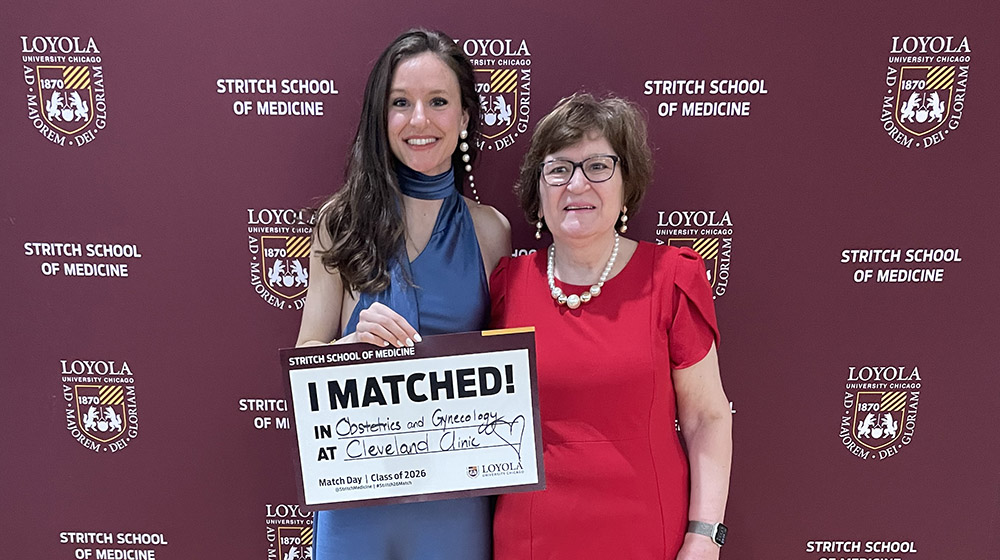
Megi Maci and her mom at Stritch's Match Day celebration on March 20, 2026.
Why did you choose Loyola?
While pursuing my undergraduate degree at Boston College, I was exposed to the Jesuit mission of being people both for and with others, as well as the concept of cura personalis, which to me means not just caring for the mind, body, and soul of a person, but also bringing my mind, body, and soul to others to meet them where they are physically, mentally, and emotionally. It was holistic accompaniment in action. This mission coincided seamlessly with my personal goal of becoming a physician. As a result, I wanted medical school to be an extension of these values, combining science and medicine with humanistic, patient-centered care.
Loyola was the perfect choice. As a Jesuit institution, Loyola translated this mission into my clinical practice, passions, and extracurricular involvements, guiding my future career in medicine as an empathetic physician leader, advocate, and champion of human rights and social justice both at the bedside of my patients and beyond.
Have you been involved in community service activities and what have those experiences meant to you?
I love service! It has formed an integral part of who I am today, and it has kept me motivated, energized, and connected to the core reasons I pursued medicine, especially during the most challenging moments of medical school.
A recurring theme throughout my community service work has been identifying and addressing gaps through partnerships to fulfill unmet needs. There is strength in solidarity and power in partnerships. Whenever we leverage this power of human connection, we can effect monumental change in pursuit of social justice and health equity.
Ultimately, I feel most aligned with my purpose when serving others, and I am deeply grateful to Stritch for allowing my passions to thrive and further illuminate my path forward as an aspiring leader in global and women’s health.
What research projects have you been involved in at Stritch?
I have been involved in multiple research projects spanning multiple interests! To name a few:
- I worked on several Alzheimer’s disease (AD) research projects, including studies investigating a stem cell therapy as a potential treatment for AD.
- Another project examines the effectiveness of Stritch’s maternal cardiac arrest management video in enhancing healthcare trainees’ knowledge to effectively respond to a maternal cardiac arrest.
- For my Community and Global Health Honors project, I designed and conducted an original scholarly project investigating the impact of demographic factors on the diagnostic accuracy of Artificial Intelligence models.
- For my Bioethics and Professionalism Honors project, my fellow colleagues and I analyzed the impact of the Stritch Immersion Program (SIP) on student-perceived preparedness for, and longitudinal academic success in, medical school.
What’s the most valuable thing you’ve learned from your medical education at Stritch?
Seeing patient-centered care in practice! It’s not enough to just treat the patient’s medical ailments. In order to really understand them, you must situate patients in the larger context of their social determinants of health and be able to address barriers to their healthcare to optimize health outcomes.
What has been the best or most memorable part of your Loyola experience?
The phenomenal people and supportive culture at Stritch! The environment in which you live, work, and study in has a tremendous impact on your mental and emotional well-being. Luckily for me, and because of its Jesuit mission that’s rooted in service and humanitarianism, Loyola attracts students who are exceptionally kind, wholesome, well-rounded, and committed to serving others—whether that be their patients or fellow classmates. I have been immensely fortunate to learn and practice medicine alongside phenomenal classmates who make medical school enjoyable. They foster a collaborative learning environment and support one another both personally and professionally.
One more thing:
I want to thank my parents for sacrificing everything to move from Albania to the United States, trading peril and poverty for the promise of the American Dream. I am forever grateful to my father for always protecting me; to my grandmother, who helped raise me while my parents worked overtime to make ends meet; and to my brother, sister-in-law, and mentors for their unwavering support.
I especially want to thank my mami, who dodged bullets during the Albanian civil war, desperate to survive for the both of us. My mother walked that day so that I could run toward my dreams today. As the roar of bullets from war transforms into the roar of applause at the finish line of this journey, accomplishments like this will always be as much yours as they are mine. Thank you, mami, for being my most ardent supporter and for shaping me into the resilient, courageous, confident, determined, and optimistic woman that I am today. You will forever be the greatest and most invaluable gift that life has given me.
I also want to personally thank my phenomenal classmates for fostering the supportive culture at Stritch. You have formed an integral part of who I am. This award is as much mine as it is yours, and I hope you all will continue to embody academic excellence, leadership, scholarship, and service in everything that you do as physicians and beyond.
Megi Maci is an aspiring physician leader pursuing Obstetrics and Gynecology (OB/GYN) who is committed to making a difference in the world. She was born in Albania in the aftermath of civil war and credits her mother’s courage, determination, and resiliency during her pregnancy in those turbulent times as her lifelong source of inspiration.
When she was two years old, Megi’s parents won the Visa lottery and left behind the peril and poverty that plagued their war-torn home country. Together with Megi, her brother, and grandmother, they immigrated to the United States—settling in Boston, Massachusetts—in hopes of creating a better future for their children.
Sixteen years later, Megi returned to Albania for the first time since her family’s departure. On the uphill path to St. Anthony’s Church, she had an eye-opening experience that would be pivotal in her decision to pursue medicine in the hopes of helping the underserved and marginalized. She recalls, “As I trekked uphill, I passed a child sitting in a wheelchair with atrophied legs; parents pleading for money to pay for surgeries; and a very young homeless girl holding her baby brother in her arms while begging for money. I saw what life was like for those who were not as fortunate as my family and me. Sheer luck separated us. Fate reunited us. We were now travelers on the same path—but I was on a different journey.”
That journey led her to medical school at Stritch, where she is now preparing to graduate as a Doctor of Medicine and continue her clinical training in residency. Megi is driven to improve the health of vulnerable populations and to practice medicine in a compassionate, dignified, and human-centered way. “Inspired by my Albanian cultural heritage, upbringing, and mentors, I hope to make advancements in women’s health and be a leader in both global and maternal health equity,” she notes.
As a physician-in-training at Stritch, she participated in both the Community and Global Health Honors Program and the Bioethics and Professionalism Honors Program. She received the prestigious Father John Fahey, SJ, Outstanding Service Scholarship and is also a four-time endowed Loyola scholarship recipient. Megi was also inducted into the Alpha Omega Alpha Honor Medical Society and the Gold Humanism Honor Society.
Below, Megi shares thoughts about her Loyola experience.
Why did you choose Loyola?
While pursuing my undergraduate degree at Boston College, I was exposed to the Jesuit mission of being people both for and with others, as well as the concept of cura personalis, which to me means not just caring for the mind, body, and soul of a person, but also bringing my mind, body, and soul to others to meet them where they are physically, mentally, and emotionally. It was holistic accompaniment in action. This mission coincided seamlessly with my personal goal of becoming a physician. As a result, I wanted medical school to be an extension of these values, combining science and medicine with humanistic, patient-centered care.
Loyola was the perfect choice. As a Jesuit institution, Loyola translated this mission into my clinical practice, passions, and extracurricular involvements, guiding my future career in medicine as an empathetic physician leader, advocate, and champion of human rights and social justice both at the bedside of my patients and beyond.
Have you been involved in community service activities and what have those experiences meant to you?
I love service! It has formed an integral part of who I am today, and it has kept me motivated, energized, and connected to the core reasons I pursued medicine, especially during the most challenging moments of medical school.
A recurring theme throughout my community service work has been identifying and addressing gaps through partnerships to fulfill unmet needs. There is strength in solidarity and power in partnerships. Whenever we leverage this power of human connection, we can effect monumental change in pursuit of social justice and health equity.
Ultimately, I feel most aligned with my purpose when serving others, and I am deeply grateful to Stritch for allowing my passions to thrive and further illuminate my path forward as an aspiring leader in global and women’s health.
What research projects have you been involved in at Stritch?
I have been involved in multiple research projects spanning multiple interests! To name a few:
- I worked on several Alzheimer’s disease (AD) research projects, including studies investigating a stem cell therapy as a potential treatment for AD.
- Another project examines the effectiveness of Stritch’s maternal cardiac arrest management video in enhancing healthcare trainees’ knowledge to effectively respond to a maternal cardiac arrest.
- For my Community and Global Health Honors project, I designed and conducted an original scholarly project investigating the impact of demographic factors on the diagnostic accuracy of Artificial Intelligence models.
- For my Bioethics and Professionalism Honors project, my fellow colleagues and I analyzed the impact of the Stritch Immersion Program (SIP) on student-perceived preparedness for, and longitudinal academic success in, medical school.
What’s the most valuable thing you’ve learned from your medical education at Stritch?
Seeing patient-centered care in practice! It’s not enough to just treat the patient’s medical ailments. In order to really understand them, you must situate patients in the larger context of their social determinants of health and be able to address barriers to their healthcare to optimize health outcomes.
What has been the best or most memorable part of your Loyola experience?
The phenomenal people and supportive culture at Stritch! The environment in which you live, work, and study in has a tremendous impact on your mental and emotional well-being. Luckily for me, and because of its Jesuit mission that’s rooted in service and humanitarianism, Loyola attracts students who are exceptionally kind, wholesome, well-rounded, and committed to serving others—whether that be their patients or fellow classmates. I have been immensely fortunate to learn and practice medicine alongside phenomenal classmates who make medical school enjoyable. They foster a collaborative learning environment and support one another both personally and professionally.
One more thing:
I want to thank my parents for sacrificing everything to move from Albania to the United States, trading peril and poverty for the promise of the American Dream. I am forever grateful to my father for always protecting me; to my grandmother, who helped raise me while my parents worked overtime to make ends meet; and to my brother, sister-in-law, and mentors for their unwavering support.
I especially want to thank my mami, who dodged bullets during the Albanian civil war, desperate to survive for the both of us. My mother walked that day so that I could run toward my dreams today. As the roar of bullets from war transforms into the roar of applause at the finish line of this journey, accomplishments like this will always be as much yours as they are mine. Thank you, mami, for being my most ardent supporter and for shaping me into the resilient, courageous, confident, determined, and optimistic woman that I am today. You will forever be the greatest and most invaluable gift that life has given me.
I also want to personally thank my phenomenal classmates for fostering the supportive culture at Stritch. You have formed an integral part of who I am. This award is as much mine as it is yours, and I hope you all will continue to embody academic excellence, leadership, scholarship, and service in everything that you do as physicians and beyond.